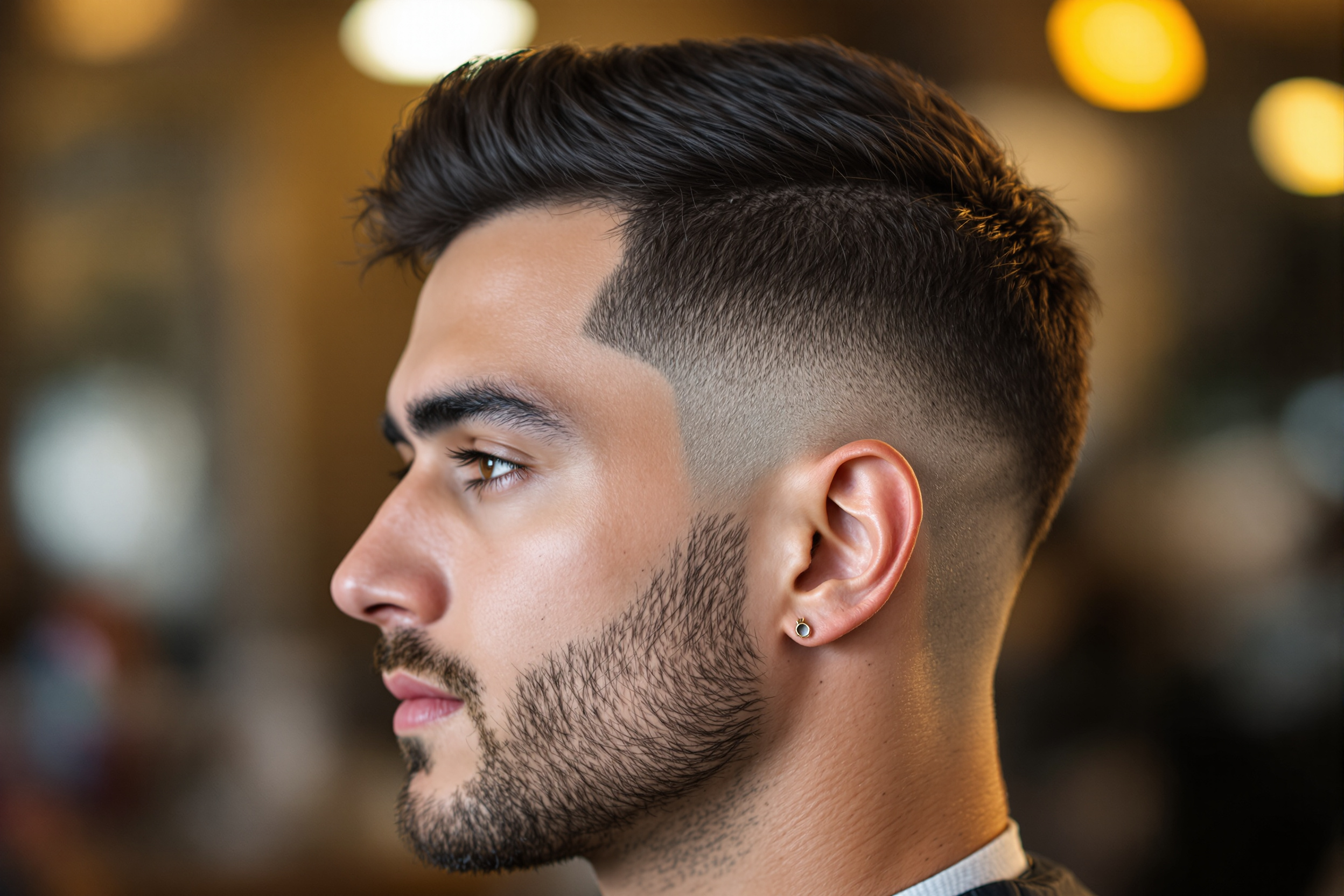
What Is a Fade, Exactly?
A fade is a haircut where the hair on the sides and back is gradually shortened from longer at the top to shorter at the bottom — "faded" down toward the skin. The exact length, where the fade starts, and how steep the gradient is determines the type of fade.
Two things to know up front:
- A fade is not the same as a taper. A taper gets shorter but does not blend into skin. A fade goes all the way down to (or near) the skin at the lowest point.
- A fade is not just "short on the sides." A buzz cut is short on the sides. A fade has a smooth gradient. The blending is the whole point.
The Types of Fades
By Height
- Low Fade — the fade starts low, around the ears and the back of the neck. Subtle and professional. Most of the hair on the sides stays at a normal short length.
- Mid Fade — starts around the temple. The most popular and most versatile. Works with almost any length on top.
- High Fade — starts high above the temple. Creates a dramatic contrast with whatever is happening on top. Bold and modern.
By Style
- Skin Fade (Bald Fade) — fades all the way down to skin at the lowest point. The sharpest fade on the menu. Requires the most maintenance because the regrowth shows fast.
- Taper Fade — the fade does not go to skin; it stops at a very short length. Cleaner than a regular taper, softer than a skin fade.
- Drop Fade — the fade line curves down behind the ear instead of running straight across the head. Modern and architectural.
- Burst Fade — fades in a semicircle around the ear, leaving the back of the head natural. Works well with longer tops, mohawks, and textured styles.
- Temp Fade (Temple Fade) — the fade is concentrated at the temples with a sharp angle. A line-up cut.
- Shadow Fade — a softer fade that does not go fully to skin, leaving a subtle shadow at the lowest point. Great for guys who want a sharp look without the high maintenance.
How to Describe What You Want
If you can give your barber three pieces of information, you will get the cut you want:
- How high does the fade start? Low, mid, or high.
- How short does it go at the lowest point? Skin, very short (1-2 guard), or short (3-4 guard).
- What is happening on top? Short and tidy, medium with texture, long with a slick-back, etc.
For example: "Mid fade down to skin, with a textured crop on top, about two inches long." Crystal clear, and a good barber can deliver exactly that.
What to Ask For (Examples)
If you are not sure how to phrase it, here are some common combinations:
- Conservative / Professional — "Low taper fade, short on top, side part."
- Modern / Versatile — "Mid fade, textured crop on top."
- Bold / Sharp — "High skin fade, slick-back on top."
- Easy Maintenance — "Low fade, short and uniform on top."
- Modern with Length — "Mid drop fade, longer top with a side sweep."
- Architectural — "High skin fade with a hard part."
Matching a Fade to Your Face Shape
Height is not just a style choice — it changes the proportions of your face, so the right fade depends on the head it sits on. A high fade adds vertical line and can lengthen a rounder face, while a low or mid fade keeps things softer and suits a longer or narrower face that does not need more length. Strong, square jaws carry a skin fade well; softer features often look better with a taper or shadow fade that does not create such a hard edge. Where you keep the weight on top matters too — volume up front balances a heavier jaw, while a flatter, textured top settles a tall forehead. If you are not sure, describe your face honestly and let the barber map the fade to it. That is exactly the kind of call a good barber makes every day.
Common First-Fade Mistakes
- Asking for "a fade" without specifics. A barber can guess, but you may not love the guess. Be specific about height and length.
- Going too short the first time. A skin fade is dramatic. If you have never had one, consider starting with a low or mid taper fade before going skin. You can always go shorter next time.
- Skipping the line-up. A fade without a clean line-up at the hairline looks unfinished. It is part of the cut, not an add-on.
- Waiting too long between cuts. Fades grow out faster than other cuts because the contrast is so visible. Plan on every 2-3 weeks for a skin fade, every 3-4 weeks for a taper fade.
- Not bringing a photo. If you have a specific look in mind, a photo eliminates 90 percent of the room for misinterpretation.
Maintaining a Fade
A fresh fade is sharp for about 7-10 days. After that, regrowth starts to blur the gradient. Here is how to keep it looking sharp longer:
- Book your next appointment when you leave. Locking in the slot two or three weeks out means you are never in the awkward grown-out stage for long.
- Wash less, condition more. Daily washing dries the scalp and roughens the regrowth.
- Brush down at the sides. A few seconds with a soft brush trains the regrowth to lay flat instead of sticking out.
- Skip home trim attempts. The gradient is hard to replicate at home. You will create a step where the fade used to be.
- Stop in for a free line-up cleanup between cuts. Many shops, ours included, will quickly clean up the hairline at no charge for regulars. Ask.
The Right Length on Top
The fade is half the cut. What is happening on top matters just as much. A few guidelines:
- 1-2 inches on top with a mid fade — versatile, easy to style.
- 3-4 inches with a low fade — works for slick-backs, pompadours, longer textured styles.
- Under an inch with a high fade — sharp, modern, low-maintenance.
- Buzzed top with a high fade — the cleanest possible look. Easy to maintain.
Talk to Your Barber
A good barber will help you choose. Tell them your hair type, your face shape, what you do for work, and how much time you want to spend on it each morning. We will recommend a fade type that actually fits your life.
If you want some background on the trade itself, the U.S. Bureau of Labor Statistics has a clear overview of what licensed barbers are trained to do. The fade is one of the techniques every modern barber masters during licensing — it is bread-and-butter work.
Hair texture belongs in that conversation. California's legal definition of barbering includes hairstyling of all textures of hair. That is a useful starting point for discussing your own hair and the result you want. The Board's barbering brochure also sets the body-area boundary: barber services are limited to the scalp, face and neck.
A training certificate and a state license mean different things. In its 2026 consumer newsletter, the Board explains that specific training can earn a certification, but certification alone does not authorize someone to provide the service without a Board-issued license. When asking about a barber's background, keep the questions separate: what license do they hold, and what experience do they have with the cut you are describing? You can ask both questions before settling on a particular style.
Ready to Try It?
Book your first fade and we will walk you through it. Bring a photo if you have one. We will deliver something sharp.